
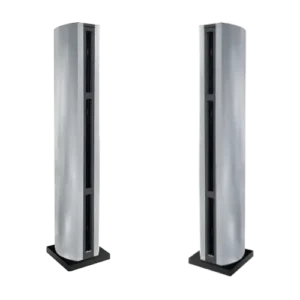

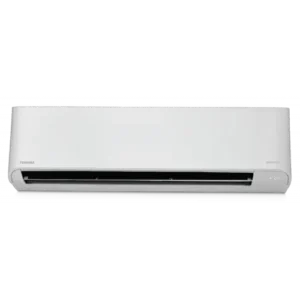







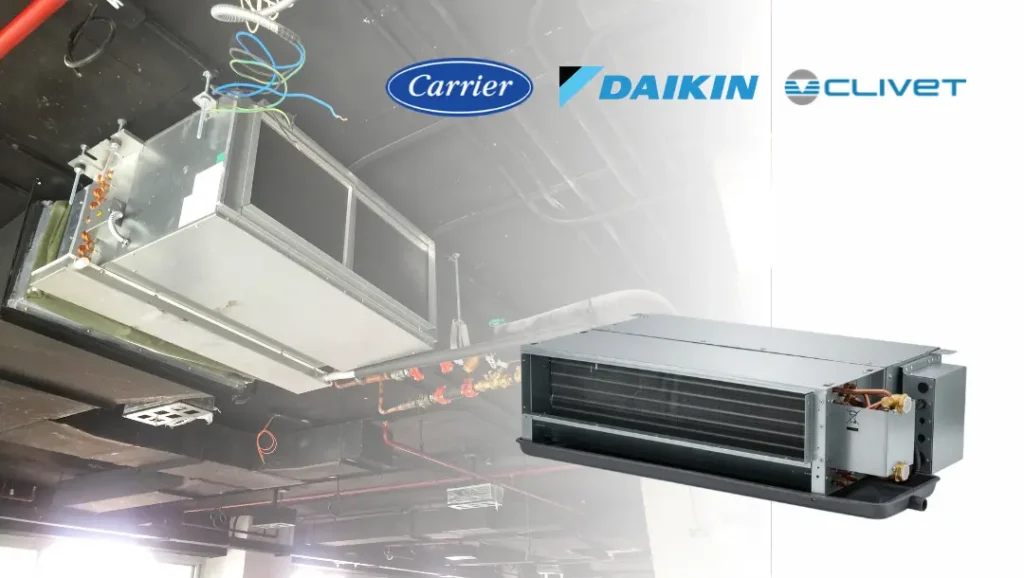
A Fan Coil Unit (FCU) is a compact HVAC terminal unit that controls the temperature of individual rooms or zones in residential, commercial, hospitality, and other buildings. A typical FCU uses a fan to draw room air across a heating or cooling coil and then circulates the conditioned air back into the space.
Fan coil units are commonly used with chilled water air conditioning systems, although some FCUs use direct expansion (DX) refrigerant coils. Depending on the system design, an FCU can provide cooling, heating, filtration, air circulation, and local temperature control.
For buildings that require independent temperature control in different rooms or zones, an FCU air conditioning system can provide a practical alternative to conditioning an entire building from one central air distribution system.
In this guide, we explain what a fan coil unit is, how an FCU works, its main components, different types of fan coil units, common applications, FCU controls, and important factors to consider when selecting an FCU for an HVAC project.
What Is a Fan Coil Unit?
A Fan Coil Unit (FCU) is an HVAC device that uses a fan and heat-transfer coil to condition air within a specific room or zone.
In a typical chilled-water FCU system, chilled water from a central chiller flows through the cooling coil. The FCU fan draws warm room air through the unit, where the air passes over the cold coil. Heat is transferred from the air to the chilled water, and the cooled air is then circulated back into the room.
For heating applications, hot water can flow through the coil instead.
According to ASHRAE, fan-coil units can provide functions including temperature and humidity control, filtration, ventilation in suitable configurations, and room air distribution. FCUs are available in different configurations, including vertical and horizontal units as well as exposed and concealed installations.
What Does FCU Stand For?
FCU stands for Fan Coil Unit.
The term describes the two fundamental parts of the equipment:
- Fan – moves air through the unit.
- Coil – transfers heat between the air and the cooling or heating medium.
A complete FCU system may also include filters, drain pans, control valves, thermostats, actuators, motors, electrical controls, and other accessories depending on the application.
How Does a Fan Coil Unit Work?
The fan coil unit’s working principle is relatively straightforward.
In a typical cooling application:
- The FCU fan draws air from the room.
- The air passes through a filter.
- The filtered air moves across the cooling coil.
- Chilled water or refrigerant removes heat from the air.
- The cooled air is discharged back into the room.
- A thermostat or controller monitors room temperature.
- The control system adjusts fan operation and/or water flow according to the cooling requirement.
In a chilled-water HVAC system, the FCU itself normally does not generate chilled water. The water is supplied from a central cooling plant, such as a chiller system.
For heating, hot water can be circulated through the heating coil to transfer heat into the room air.
This arrangement allows individual rooms or zones to be controlled according to their own temperature requirements.
Main Components of a Fan Coil Unit
The exact configuration varies by manufacturer and application, but the main fan coil unit components generally include the following.
1. Fan and Motor
The fan moves air through the FCU and into the conditioned space.
Different motor and fan arrangements can be used depending on the required airflow, noise level, efficiency, and control requirements. Traditional FCUs may use multi-speed motors, while newer systems can use electronically commutated motors (ECMs) for improved control and efficiency.
2. Cooling or Heating Coil
The coil is the primary heat-transfer component.
For cooling, chilled water or refrigerant passes through the coil and absorbs heat from the air flowing across its surface.
For heating, hot water or another heating medium can transfer heat into the air.
Hydronic FCUs can use chilled water, hot water, or both depending on the system design. DX FCUs use refrigerant instead of chilled water.
3. Air Filter
The filter captures airborne particles before air passes through the coil and other internal components.
Regular inspection and replacement of the filter are important because a dirty filter can restrict airflow and reduce system performance.
ASHRAE notes that terminal units using recirculated air should have an accessible air filter for inspection and periodic replacement.
4. Drain Pan
During cooling operation, moisture can condense on the cooling coil when warm, humid air comes into contact with the cold coil.
The condensate collects in the drain pan and is discharged through the condensate drain system.
Proper drainage is particularly important in humid environments because blocked or poorly installed condensate drains can lead to water leakage and damage.
5. Thermostat or Temperature Controller
An FCU thermostat measures room temperature and controls the operation of the unit.
Depending on the control system, the thermostat may:
- Turn the fan on or off.
- Select fan speed
- Control a chilled-water valve.
- Control a hot-water valve.
- Adjust the temperature set point.
- Communicate with a building management system.
More advanced systems can use modulating valves, ECM motors, digital controllers, or building automation systems.
6. Control Valve
In a chilled-water FCU, a control valve regulates the flow of water through the coil.
A two-way or three-way valve may be selected depending on the HVAC design and control strategy.
Pressure-independent control valves and other valve accessories can also be incorporated into hydronic FCU piping packages.
7. Casing and Insulation
The casing protects the internal components and provides the required airflow path.
FCUs may be exposed or concealed. Internal insulation can be used for thermal and acoustic purposes, depending on the equipment design.
Types of Fan Coil Units
Fan coil units are available in several configurations. The appropriate type depends on the available installation space, required capacity, appearance, airflow arrangement, and project requirements.
1. Vertical Fan Coil Unit
A vertical FCU is installed vertically and may be exposed or concealed.
Vertical units are commonly used in:
- Apartments
- Hotels
- Offices
- Residential buildings
- Schools
- Other individual zones
Some vertical FCUs can be installed beneath windows or inside cabinets.
2. Horizontal Fan Coil Unit
A horizontal FCU is generally installed above a ceiling or in another overhead location.
These units are often used where floor space is limited and concealed ceiling installation is preferred.
Horizontal FCUs can be designed as blow-through or draw-through configurations, depending on how the fan and coil are arranged.
3. Concealed Fan Coil Unit
A concealed FCU is installed above a false ceiling, inside a ceiling void, or within another concealed location.
Only the air grilles or diffusers may be visible from the occupied space.
This configuration is often selected for offices, hotels, apartments, villas, and commercial interiors where a clean appearance is required.
4. Exposed Fan Coil Unit
An exposed FCU has its casing visible within the room.
It can be useful where easy access to the equipment is required or where a concealed installation is not practical.
5. Vertical Stack Fan Coil Unit
Vertical stack FCUs are designed for buildings where multiple units are installed vertically, such as hotels, apartments, and high-rise residential buildings.
They can be connected to vertical chilled-water and hot-water piping systems serving multiple floors. ASHRAE identifies vertical stack FCUs as a configuration used in high-rise hotels, condominiums, dormitories, and residential buildings.
Two-Pipe vs Four-Pipe FCU Systems
One important consideration when designing a fan coil unit HVAC system is the water-piping arrangement.
Two-Pipe FCU System
A two-pipe system has:
- One supply pipe
- One return pipe
The same piping circuit can be used for heating or cooling depending on the system operating mode.
This arrangement can have a simpler installation and lower initial cost, but it has limitations when different zones require heating and cooling at the same time.
Four-Pipe FCU System
A four-pipe system normally has:
- Chilled-water supply
- Chilled-water return
- Hot-water supply
- Hot-water return
This allows heating and cooling to be available independently.
Four-pipe systems can provide greater flexibility for buildings where different zones may have different thermal requirements at the same time. ASHRAE describes four-pipe systems as providing simultaneous heating and cooling availability at individual units, subject to the system design.
Where Are Fan Coil Units Used?
Fan coil unit applications cover a wide range of buildings and HVAC systems.
Residential Buildings
FCUs can be used in:
- Apartments
- Villas
- Residential towers
- Condominiums
- Multi-family buildings
They allow different rooms or zones to have individual temperature control.
Hotels and Hospitality
Hotels commonly require individual room temperature control.
An FCU can serve individual guest rooms or zones while connecting to the building’s central chilled-water system.
Commercial Offices
FCUs can provide zone-level temperature control in office spaces, meeting rooms, corridors, and other areas.
Depending on the project design, units may be concealed above ceilings or installed in accessible service areas.
Schools and Educational Buildings
FCUs can be used to condition classrooms, offices, and other occupied spaces where individual zone control is required.
Healthcare and Other Specialised Buildings
FCUs may also be used in selected healthcare, institutional, and specialised applications, provided the equipment configuration, filtration, ventilation, hygiene, access, and control requirements are appropriate for the application.
FCU vs AHU: What Is the Difference?
A common HVAC question is the difference between an FCU and an AHU (Air Handling Unit).
An FCU is generally a smaller terminal unit designed to condition a particular room or zone.
An AHU is typically a larger air-handling system designed to process and distribute air to one or multiple areas through ductwork.
| Typical application | Individual room or zone | Multiple zones / larger areas |
| Size | Compact | Larger |
| Air distribution | Local or limited ductwork | Usually ducted |
| Temperature control | Often local | Central/system-level |
| Installation | Room, ceiling, cabinet or concealed space | Plant room, service area or roof |
| Air filtration | Basic to application-specific | Can accommodate more advanced filtration |
| Fresh-air handling | May require separate system or connection | Can be designed specifically for outdoor air |
| Typical use | Hotels, apartments, offices | Commercial buildings, hospitals, large facilities |
The exact difference depends on the HVAC system design. ASHRAE describes FCUs as smaller, factory-made terminal assemblies that can provide temperature control, filtration, ventilation in suitable configurations, and room air distribution.
FCU vs Split AC: What Is the Difference?
An FCU and split AC are not the same type of equipment.
A conventional split AC normally includes an indoor unit connected to an outdoor condensing unit through refrigerant piping.
A chilled-water FCU, on the other hand, generally receives chilled water from a central chilled-water system.
FCU systems are often considered when:
- A building already has a central chilled-water plant.
- Individual zone control is required.
- Multiple rooms need independent temperature control.
- The project uses a central hydronic HVAC system.
Split AC systems may be considered when:
- Individual spaces require independent air-conditioning systems.
- There is no central chilled-water plant.
- A smaller standalone installation is appropriate.
The right solution depends on the building type, cooling load, available infrastructure, energy strategy, installation constraints, and project requirements.
FCU Thermostats and Controls
Temperature control is an important part of any FCU air conditioning system.
A basic FCU thermostat may provide:
- Temperature set-point adjustment
- On/off control
- Fan speed selection
- Cooling/heating mode selection
- Valve control
More advanced systems may use:
- Digital thermostats
- Programmable controls
- Modulating valves
- ECM fan motors
- Building Management System (BMS) integration
- Direct Digital Control (DDC)
ASHRAE notes that fan-coil controls can range from simple thermostat-based fan and valve control to more advanced modulating components and building automation integration.
For projects requiring accurate temperature control, the thermostat, valve, actuator, motor, and FCU should be selected as a compatible control system rather than as completely independent components.
Benefits of Fan Coil Units
The popularity of FCUs in residential and commercial HVAC systems comes from their flexible configuration and zone-control capabilities.
Individual Zone Control
Each FCU can serve a specific room or zone, allowing temperature settings to be adjusted according to occupancy and comfort requirements.
Compact Design
FCUs generally require less space than large central air-handling equipment at the room level.
Flexible Installation
Vertical, horizontal, exposed, concealed, and stack configurations allow FCUs to be adapted to different building layouts.
Suitable for Central Chilled-Water Systems
FCUs can be connected to a central chilled-water plant, making them suitable for buildings with centralised cooling infrastructure.
Easy Access for Maintenance
Depending on the configuration, filters, fan assemblies, coils, valves, and controls can be designed for relatively accessible servicing.
Suitable for Different Building Types
FCUs are used across residential, hospitality, commercial, institutional, and other applications where zone-level conditioning is required.
Important Factors When Selecting a Fan Coil Unit
Choosing an FCU for an HVAC project requires more than simply selecting a unit based on physical size.
Consider the following factors:
1. Cooling Capacity
The FCU should have sufficient cooling capacity for the calculated room or zone load.
An undersized unit may struggle to maintain the required temperature, while an oversized unit may lead to unnecessary cycling and poor humidity control depending on the application.
2. Airflow
The required airflow should match the room load, air-distribution design, and external static pressure where applicable.
ASHRAE recommends selecting the FCU fan based on the required design airflow and external static pressure.
3. Water Flow and Coil Selection
For chilled-water systems, the coil must be selected according to the required cooling capacity, entering-water temperature, leaving-water temperature, airflow, and water flow conditions.
4. Noise Level
For bedrooms, hotel rooms, offices, and other noise-sensitive areas, acoustic performance should be considered.
5. Installation Space
Check:
- Unit dimensions
- Ceiling height
- Access requirements
- Pipe connections
- Condensate drainage
- Filter access
- Maintenance clearance
6. Control Compatibility
Confirm that the FCU is compatible with the proposed:
- Thermostat
- Control valve
- Actuator
- Fan motor
- BMS or control system
7. Maintenance Requirements
Select equipment that allows practical access to filters, coils, fans, motors, drain pans, valves, and electrical components.
Common FCU Problems
Like other HVAC equipment, fan coil units require proper installation and regular maintenance.
Common issues include:
Reduced Airflow
Possible causes include:
- Dirty air filter
- Dirty coil
- Fan or motor problems
- Blocked air path
- Incorrect fan speed
Insufficient Cooling
Possible causes can include:
- Inadequate chilled-water flow
- Dirty coil
- Incorrect control settings
- Insufficient airflow
- Incorrect unit selection
- High room heat load
Water Leakage
Condensate leakage can result from:
- Blocked drain pipe
- Incorrect drain slope
- Damaged drain pan
- Poor insulation
- Excessive condensation
Unusual Noise
Noise may be associated with:
- Fan imbalance
- Motor problems
- Loose components
- Incorrect installation
- Excessive airflow
- Poor vibration isolation
Proper commissioning, installation, inspection, and maintenance can help reduce these problems.
How to Maintain a Fan Coil Unit
Regular FCU maintenance helps maintain airflow, cooling performance, indoor comfort, and equipment reliability.
A basic maintenance program may include:
- Inspecting and replacing air filters
- Cleaning cooling and heating coils
- Checking fan and motor operation
- Inspecting electrical connections
- Checking control valves and actuators
- Inspecting condensate drain lines
- Cleaning the drain pan
- Checking insulation
- Checking thermostat operation
- Inspecting abnormal vibration or noise
- Verifying airflow and temperature performance
The maintenance frequency should be based on the manufacturer’s recommendations, operating environment, occupancy, and building conditions.
Is an FCU Suitable for Your HVAC Project?
A fan coil unit can be a practical solution when a project requires individual zone temperature control, compact equipment, and integration with a central chilled-water or heating system.
However, FCU selection should be based on the actual project requirements rather than choosing a unit only by nominal capacity.
Cooling load, airflow, water temperature, water flow, external static pressure, noise requirements, installation location, controls, maintenance access, and ventilation requirements should all be considered.
For larger projects, HVAC consultants and MEP engineers should coordinate the FCU selection with the overall chilled-water, ventilation, electrical, controls, and building management systems.
Conclusion
A Fan Coil Unit (FCU) is an important component of many modern HVAC systems, particularly where individual room or zone temperature control is required. Its basic operation combines a fan, heat-transfer coil, filtration, and temperature controls to circulate conditioned air within the occupied space.
From chilled-water FCUs in hotels and residential towers to concealed ceiling units in commercial offices, different FCU configurations can be selected according to the building layout and HVAC system design.
For a successful installation, it is important to consider cooling capacity, airflow, coil performance, water flow, controls, noise, installation space, condensate drainage, and maintenance access.
If you are sourcing FCU-related HVAC products, thermostats, control valves, actuators, or other HVAC components in the UAE, Cannelle Holdings can assist with product availability and project requirements.
Need HVAC materials for your project? Contact Cannelle Holdings for product availability, technical specifications, and quotation support.
